
BIOGRAPHICAL SKETCH: AVARD T. FAIRBANKS, Ph.D., SCULPTOR
Avard Tennyson Fairbanks was born in Provo, Utah on March 2, 1897. He was the 10th child of John B. Fairbanks, an early Utah artist. His mother died when he was an infant. Thereafter, he was raised by his teenaged sister, Annetta. Because of not being raised by his own mother, Avard T. Fairbanks both idolized and idealized women. This is well-demonstrated in his sculptured works of women. At an early age, he showed an intuitive artistic talent. His father and oldest brother, J. Leo Fairbanks, who was an accomplished artist, were both very encouraging of the talents of young Avard. His earliest sculptured work was that of a pet rabbit at age 7, and it won him a 1st Prize at the Utah State Fair. However, when the judge realized that it was done by an 7-year-old boy, they removed the ribbon which was a great disappointment to the young sculptor. At age 12, he traveled to New York with his father. J. B. Fairbanks, a noted landscape painter. There, he studied in the metropolitan museum and made animal sculptures in the Bronx Zoo. He was featured in New York Times newspaper in a number of articles, and he met multiple famous sculptors while studying in New York. Avard’s initial goal was to become an animal sculptor. This would change in time. At age 13½, he created a study of the Charging Buffalo. At age 14, he created a Lion in cold butter at the Utah State Fair, similar to the Lion in Butter modeled by a youthful Renaissance Italian sculptor, Antonio Canova. At age 16, he went to Paris with his father where he studied at the Ecole Nationale Des Beaux-Artes Ingelbert, also at Ecole D’La Grand Chaumiere Academie Calarosi, and Ecole Moderne. He and his father escaped to Europe following the outbreak of World War I with the Germans advancing on Paris. They were able to catch the last train to the coast and leave from Liverpool, England, by ship to New York. Avard T. Fairbanks returned to Utah and did formal schooling at the University of Utah in 1918. During his 20s when he was doing commissioned sculptured works on the L.D.S. Hawaiian Temple, he married Beatrice Maude Fox in Hawaii. Thereafter, he accepted a teaching position at the University of Oregon in Eugene. He ultimately graduated from Yale University with a Bachelor of Fine Arts in 1925. While in Oregon, he placed a number of major heroic statues, including the American Dough Boy, or Victorious American Soldier in 1919. One was erected in St. Anthony, Idaho, and another in Moscow, Idaho. He carved an exquisite Venus figure called Aphrodite Awakening (or the birth of Aphrodite), in marble for the Washburn Gardens in Eugene, Oregon. He also erected a five-figure heroic memorial to the 91st Division in World War I at Fort Lewis, Washington. Avard T. Fairbanks subsequently accepted a Guggenheim Fellowship to study in Florence, Italy, in 1928 where he was accompanied by his wife and four sons. The Nursing Motherhood statue carved in cream-colored Seravezza marble, which is currently displayed in the Springville Museum in Utah, was carved during this period. He also carved the Primavera, an exquisite standing female figure in marble. When he returned to Italy after World War II, he was able to retrieve the Nursing Motherhood, but the Primavera had disappeared. The location of this remarkable marble statue remains unknown. A bronze casting of the working model of the Primavera, however, has been preserved and cast in bronze. Following the fellowship in Italy, he joined faculty of the University of Michigan and served there as Professor of Sculptor for 18 years. Four more sons were born in Ann Arbor, Michigan. While at the University of Michigan, he held annual sculpture exhibits in the Women’s League Building on campus demonstrating works of his students. He obtained both a Masters Degree and a Ph.D. degree from the University of Michigan. His Ph.D. degree thesis was entitled “Anatomical Design,” for which he made many human anatomic sculptures as the result of dissecting a total of 30 human cadavers. The Dean of the Graduate School, G. Carl Huber, M.D., was greatly supportive of Avard T. Fairbanks in doing his anatomical studies. Like Michelangelo and Leonardo Da Vinci, Avard Fairbanks became an outstanding anatomist and it is displayed in his works. While in Michigan he was called on by the automotive industry to create a number of radiator ornaments, or hood ornaments, for cars of the 30s. One was an imposing Griffin (a mythical animal half bird/half lion) for the Essex Terraplane which subsequently became the Hudson Automobile. The Essex Terraplane with its powerful straight eight-cylinder engine set the record for the Pike’s Peak auto endurance climb. He created an exquisite winged mermaid called Floating Power for the Plymouth Automobile (The Plymouth automobile was the first to have rubber engine mounts which reduced vibration into the frame). Later, he was called on by Walter P. Chrysler to create a radiator ornament for the Dodge car. The Dodge line of cars and trucks had recently been acquired by Mr. Chrysler from the Dodge Brothers. When Mr. Chrysler came to inspect the various models that Avard Fairbanks had made, he asked, “Well, Fairbanks, what do you think we should put on the Dodge?” Avard Fairbanks replied, “I think the Ram would go well on the Dodge, Mr. Chrysler.” “And why is that?” Mr. Chrysler asked. Avard Fairbanks replied, “The Ram is the King of the Trail – when people see the Ram, they’ll Dodge.” Mr. Chrysler exclaimed, “That’s it! Ram goes on the Dodge!” and it has been there ever since. While at Michigan, Avard Fairbanks made a number of monumental statues which included the Colt Pegasus for the Dodge Wilson Estate in Rochester, Michigan, and also Lincoln the Frontiersman which went to the Ewa Plantation in Oahu, Hawaii, not far from Pearl Harbor. He created a Percheron stallion from a live giant stallion named Obuzier. This was cast in bronze during the latter part of his lifetime and was donated to Michigan State University. A period newspaper article, which included a photograph of the sculptor and the horse, stated that it was intended for Michigan State College – which subsequently became Michigan State University. He created the three-figure Pioneer Family for the Capital Grounds in Bismark, North Dakota. He made a number of portrait busts including one of Dean G. Carl Huber, another of former University of Michigan President Clarence C. Little, and a portrait bust of the wife of Alexander Grant Ruthven, President of the University of Michigan at the time. He also made a portrait bust of Walter P. Chrysler. He made multiple beautiful figure studies from life while at the University of Michigan. These were and are some of his most exquisite pieces of work which evoke universal appeal. This included the Flower Girl, as well as the Shell Boy which was a flowing fountain figure piece that won the Gold Medal at the North American Flower Show in Detroit in 1934. He created a kneeling nude figure from life entitled Rain, another of a female figure enclosed in a circular orb was entitled Nebula. This work was exhibited at the 1939 World’s Fair in New York City. A famous anthropologist remarked, “All the Venuses must hide their laurels now that Fairbanks created Nebula.” A smaller figure study which was never enlarged to life-size was called the Spirit of the Wind, or Zephyr. It was a helmeted nude female figure riding a cloud with wings on the helmet and wings on the feet. Another Art Deco figure study arising as if with plants in the Spring is called Dalla Terra (from the Earth). In 1947, Avard T. Fairbanks moved to Utah to accept the position of Dean of the College of Fine Arts which school he organized and became its first dean. While actively engaged in teaching and administration, he continued to create major monuments which included the heroic Lincoln the Lawyer for the Lincoln Square in Chicago, Lincoln for New Salem, Illinois, Lycurgus – a 9-foot statue of the ancient King of Sparta, Greece – which went to Sparta in 1955. Another was Daniel C. Jackling who was the founder of Utah (Kennecott) Copper. The statue is now in the Utah State Capitol building. He created a statue of Albert Woolson, the last survivor of the American Civil War who, at age 107, posed for Avard T. Fairbanks. The sitting statue of this elderly veteran in bronze resides east of Cemetery Ridge on the Gettysburg Battlefield, behind Cemetery Ridge. Marcus Whitman, M.D., for the State of Washington and Ester Morris for the State of Wyoming both reside in Statuary Hall in Washington, D.C., representing their respective States. Four marble heads of Abraham Lincoln were donated to the Ford Theatre Museum – the location of Lincoln’s assassination. Eventually, Avard T. Fairbanks retired from the Deanship but continued on as Professor of Sculpture of the University of Utah until the time of his retirement. He continued to do commission sculpture work. He spoke fluent French and Italian. He never relinquished his Italian connections, and every other year he would go to Italy and do marble carving in Pietrasanta, Italy. After retirement from the University of Utah, he accepted a position as Resident Sculptor on Campus at the University of South Dakota where he continued to create more sculpture. Avard T. Fairbanks continued creating sculpture up until the time of his death. He occupied a studio just east of the Salt Lake City Airport in a converted World War II military building. He also had a studio in an old historic church building in the community of Granite, just west of Little Cottonwood (Alta) Canyon. In order to preserve this building and a collection of his work, it was purchased out of the family estate by his youngest son, Grant R. Fairbanks, M.D., after his death. It is currently on the National Register of Historic places. In 1987, Avard T. Fairbanks, Ph.D. suffered an initial heart attack and appeared to be recovering. However, he had a recrudescence one week later, and he went on to die in cardiac arrest. His youngest son, Grant R. Fairbanks, M.D., was at his bedside holding his hand when he passed on. Two weeks following his death, a major retrospective exhibit of his works was held at the Salt Lake Art Center in downtown Salt Lake City next to Abravanel Hall. This exhibit went from January 16 to March 6, 1988. It was subsequently shown from September 30 to November 14 at the Harris Fine Arts Center at Brigham Young University. There are over 100 sculptured works by Avard T. Fairbanks, Ph.D. on public display in the U.S. and abroad.

Avard Fairbanks with Colossal Christ Head
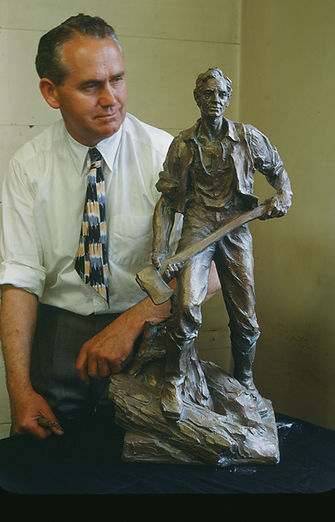
Avard Fairbanks with model
for Lincoln the Frontiersman


As early as age 7, Avard Fairbanks was showing a propensity for artistic achievement. As a youth, he intended to become an animal sculptor. At age 8, he created a rabbit for the Utah State Fair. At age 11, he was in New York creating `sculpture of a lion in the Bronx Zoo. He went to Paris with his father at age 12 to study art, and while in Paris, he created the small, seated Girl Selling Flowers. He also created the Turkish Rug Salesman. At an early age, he created a Seated Child Playing on the floor in a dress reading a book. He created a Prize Bull for Winder Dairy, and he also created a Charging Buffalo at age 14. There is a large model and a small model of this Buffalo. The large model is cast in bronze and is on display on the front grounds at the Springville Art Museum.
Part of Avard’s interesting history as a boy is that he sculpted a Lion in Butter for the Utah State Fair. This is reminiscent of famous renaissance Italian sculptor, Antonio Canova, who similarly sculpted a Lion in Butter for a special occasion as a boy.