
Grant R. Fairbanks M.D.


Dr. Fairbanks was born in Ann Arbor, Michigan, the eighth son of Avard T. Fairbanks, Ph.D. and his wife, Maude Fox Fairbanks. His father was Professor of Sculpture at the University of Michigan and served there for 18 years before accepting a post as Dean of the College of Fine Arts at the University of Utah. Grant R. Fairbanks had to leave Michigan as a boy with his parents when the family moved to Utah. This meant leaving all of his friends and his wonderful Michigan experiences behind; nevertheless, he has always considered himself a Michigander. In Utah, he graduated from East High School; he completed his pre-medical undergraduate school at the University of Utah, earning a B.S. Degree with Honors. He entered medical school at the University of Utah and was elected as Class Historian, creating the class annual book – The Medicine Man – for the time of his class graduation. In medical school, Dr. Fairbanks studied under such notable professors as Maxwell Wintrobe, M.D., a famous internist who published a textbook on hematology and had a major influence on upgrading the medical school. In pharmacology, he studied under Dr. Louis Goodman who wrote a pioneering pharmacology textbook. Another notable surgical faculty member was Petter Lindstrom, M.D., a neurosurgeon, who was the former husband of motion-picture actress Ingrid Bergman, who had an extramarital love affair with Roberto Rossellini when filming the motion picture “Stromboli” in Italy. This resulted in their divorce. It was during the summer vacation months of medical school that Dr. Fairbanks received the commission to create the colossal eagle for the Eagle Gate in downtown Salt Lake City. This was a monumental sculptural achievement which had an enormous influence on his life. He had grown up doing sculpture with his father and doing painting with his brothers. During his pre-medical years, he took all the requisite art courses to become an artist as well as the required pre-medical courses. During his senior year in medical school, he was commissioned by members of the Department of Microbiology to create a sculptured bust of Louis P. Gebhardt, M.D., founder of the department and pioneer in the field. The bronze casting of this portrait bust is on exhibit at the University of Utah Medical School Library. Dr. Fairbanks’ initial goal after graduating from medical school was to become a neurosurgeon. However, when he visited the neurosurgical program of his choice and visited the neurosurgical intensive care unit, he noted that all the patients were comatose. It was like a human vegetable garden with tubes going in and tubes going out. This planted seeds of doubt in his mind regarding neurosurgery as his chosen profession, and as an intern after scrubbing in on an intracranial arteriovenous malformation with two neurosurgeons, he made the decision against becoming a neurosurgeon. His brother, David N.F. Fairbanks, M.D., stated, “With your artistic ability, you should go into plastic surgery.” With that in mind, he sought out plastic surgery programs and the best program he found happened to be at the University of Michigan in Ann Arbor, his hometown. He visited with the Chief of Plastic Surgery there, Reed O. Dingman, M.D., who expressed an interest in him but advised him that all of their candidates had to become general surgeons first because it ensured that they were not limited to any part of the body. Dr. Fairbanks completed his General Surgery Residency under Dr. Robert Buxton at the University of Maryland in Baltimore. During his tour of duty at Maryland, he joined the Maryland National Guard and became Battalion Surgeon for the 110th Artillery Battalion in Pikesville, Maryland. His unit was called up after the assassination of Martin Luther King; it was activated for Riot Duty; therefore, he served as active-duty U.S. Army on the streets of Baltimore with the National Guard for two weeks. He had offers to go into General Surgery practice in Baltimore which he declined. Following his general surgery residency, he moved to Ann Arbor, Michigan, for his Plastic surgeon Surgery Residency under Dr. Reed O. Dingman. In the mid-portion of his residency, Dr. Dingman arranged for him to serve a two-month off-campus assignment as Plastic Surgeon on the Hospital Ship Hope in Tunis, Tunisia. This turned out to be an extraordinary experience and one in which Dr. Fairbanks was able to perform many major operations, and even create a new operation for restoration of the oral commissure. While on the ship, he even performed a total nose reconstruction in three stages. Dr. Fairbanks spent a rotation in Detroit, Michigan, under Dr. Joseph Posche in a hand-surgery program which is an important part of plastic surgery. He became proficient in hand surgery. Once completing his residency in plastic surgery, Dr. Fairbanks accepted a faculty position at the University of Cincinnati which did not have a plastic surgical program; Dr. Fairbanks’ intention was to create a program there. Cosmetic surgery at the University of Cincinnati was being performed by the ENT Department which was separate from the Department of Surgery. Dr. Fairbanks took over the Hand Surgery Clinic at the University of Cincinnati. He operated at four different hospitals and performed many operations with general surgery residents, assisting at surgery in order to learn plastic surgery techniques and principles. It soon became clear thereafter that his Chief, Dr. William Altemeier wanted his plastic surgeon to be assigned to the Cincinnati Burn Unit. Taking care of major burns was not on the list of Dr. Fairbanks’ priorities. He had taken care of many major burn patients, in Baltimore, as well as on Hospital Ship Hope in Tunisia. His decision to leave the University of Cincinnati, however, came as the result of a hand case which needed emergency surgery having been inappropriately cancelled by Dr. Altemeier because of comments made by a junior faculty general surgeon. The case was a paint-sprayer injury to the index finger which, without being opened up immediately and cleaned out, would result in the loss of the patient's finger. And that is exactly what happened. As the result of the cancellation of the emergent surgery, the finger became gangrenous and had to be amputated. This was a hand surgery case. Dr. Fairbanks was Chief of Hand Surgery. He could not function in an environment where someone else could cancel his surgery; therefore, he left Cincinnati. Dr. Fairbanks decided to move back to Utah and go into the private practice of Plastic Surgery. He had many friends and referring colleagues in Utah who encouraged him to return. He joined the staff of St. Mark’s Hospital as his primary affiliation, and he also became Associate Professor of Surgery at the University of Utah, joining the clinical or adjunct faculty role of practicing doctors who also taught residents at the University of Utah. He became active in the Utah Medical Association, serving first as Chairman of the Legislative Committee and subsequently serving as Treasurer of the Utah Medical Association. Dr. Fairbanks created the first plastic surgery office-based surgical facility in Utah. He created an operation room comparable in size and function to those in the hospitals. This offered surgery, primarily cosmetic surgery – not covered by medical insurance – at an affordable rate as compared to hospital costs. At the recommendation of the State’s senior plastic surgeon, Dr. T. Ray Broadbent, Dr. Fairbanks organized the Utah Plastic Surgery Society as a component society of the Utah Medical Association; Nominated by Dr. Broadbent, Dr. Fairbanks served as its first President. While in Utah, he also pursued artistic interests. Together with his sons, he rescued many of his father’s classic garden/figure statuary which his father had generously loaned out to a wide variety of people and institutions. The statues that were damaged, he repaired after which finishing touches were applied by his father before these statues were cast in bronze during his father’s lifetime. While in Utah, he also pursued artistic interests. Together with his sons, he rescued many of his father’s classic garden/figure studies statuary which his father had generously loaned out to a wide variety of interested people. Statues that were damaged, he repaired after which finish touches were applied by his father before having these statues cast in bronze. Dr. Fairbanks was the founding President of the Utah State Plastic Surgery Society. He is past President of the Reed O. Dingman Society for Plastic Surgery at the University of Michigan. He served as an officer in the Utah Medical Association and as Chairman of the Department of Surgery at St. Mark’s Hospital in Salt Lake City. Dr. Fairbanks served in the U.S. Military as Capt. M.C. in the 144th Evacuation Hospital, Utah National Guard; as Battalion Surgeon in the 110th Artillery, Maryland National Guard; and as Commanding Officer of the 381st General Dispensary, USAR, Ann Arbor, Michigan. Grant R. Fairbanks, M.D. grew up assisting his father in the sculpture studio. He also learned painting early in life, especially from his brother, Jonathan. As a teenager, he took watercolor painting courses from Harold Olsen. During his undergraduate years at the University of Utah , he not only completed his pre-medical studies, but he also completed training in art and sculpture. He studied under Florence Ware, LeConte Stuart, George Dibble, and Alvin Gittins in drawing and painting. He also attended classes in sculpture taught by his father, Avard T. Fairbanks, Ph.D. By the time he entered medical school, he was already an accomplished artist. Dr. Fairbanks combines Art with Medicine in the form of Plastic Surgery. He believes that Plastic Surgery is the finest of the Fine Arts. Dr. Fairbanks comes from an artistic background by both heritage and education. His father, Avard T. Fairbanks, Ph.D., was an internationally renowned sculptor. Throughout his youth Dr. Fairbanks worked in his father’s studios, learning the sculpture profession and appreciation of classical sculptural beauty. His own talents were enhanced by studies with many of Utah’s most noted artists. From his own artistic accomplishments, the best known is his sculptural re-creation of the Eagle for Salt Lake City’s famed Eagle Gate. He also created a bronze portrait of Louis P. Gebhardt, M.D., Professor of Microbiology, which is located in the University of Utah Medical Library. The large relief of the Great Seal of the State of Utah behind the Utah Governor’s desk is another of his artistic accomplishments. A bronze statue of the winged horse “Pegasus” for the Pegasus Critical Care Center for large animals, Michigan State University Veterinary school, East Lansing, Michigan is another of his sculpting achievements. He created the Medal of Honor for the William C. Grabb, M.D. Memorial Lectureship at the University of Michigan. He has painted Still-lifes, Landscapes, Seascapes, Portraiture, Figure Studies, and done medical illustrations; he is an excellent painter of the human figure. Dr. Fairbanks is a recipient of the prestigious Jerome Klingbeil Award for excellence in teaching by the American Society for Aesthetic Plastic Surgery. Dr. Fairbanks is accomplished in all areas of Plastic Surgery. In professional circles, he is best known for his special experience in dealing with difficult problems of the nose and face. He believes that breathing and appearance are interdependent. His expertise is correcting intranasal airway problems as well as achieving improvement in nasal form. His services are frequently sought by patients who have had unsatisfactory prior nasal surgery He is experienced in restoration of beauty to the torso, including breasts and abdomen, and contouring of the hips, and thighs. Breast enlargement (augmentation), breast lifting (mastopexy), breast reduction, and breast reconstruction are all procedures which Dr. Fairbanks performs with consummate skill. With regard to the aging face, (facelift) Dr. Fairbanks has made many technical innovations to improve on state-of-the-Art techniques whereby patients can expect significant rejuvenation without appearing tight, stretched, or unnatural. He is accomplished as a scholarly writer and lecturer, and has served as a visiting professor for professional groups in the USA and internationally. He teaches a symposium to Plastic Surgeons on Medical Life Drawing and Sculpture in Plastic Surgery at a national professional society meeting. Dr. Fairbanks is nationally recognized as a member of the American Society for Aesthetic Plastic Surgery and the American Society of Plastic Surgery. He is a member of the Reed O. Dingman Society of the University of Michigan, The Salt Lake Surgery Society, the Utah State Plastic Surgery Society, and the President’s Council Society, Oakland University, Rochester, Michigan. Dr. Fairbanks is certified by the American Board of Surgery and the American Board of Plastic Surgery. He is an Adjunct Professor of Surgery at the University of Utah School of Medicine.
 |  |  Springville Museum gave miniature Eagle Gate to Grant R. Fairbanks M.D. after exhibit. |  Grant R. Fairbanks M.D. with his family under the miniature Eagle Gate in the Springville Museum in 2023 |  |  |
|---|---|---|---|---|---|
 Dr. Fairbanks inspecting newly bronzed Eagle for Eagle Gate. |  Approval of full size plaster for Eagle Gate. |  The Eagle Gate dedication in 1963 with brothers; Justin, David and Grant R. Fairbanks. |  Eagle Gate today. |  William C. Crabb, M.D. Medal of Honor |  Copy of the Girl With the Pearl Earring, by Vermeer |
 Model posing at Grant R. Fairbanks’ art studio. |  Dr. Fairbanks’s painting studio. |  Model for Joan of Arc | 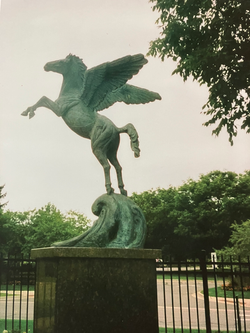 Dr. Grant R. Fairbanks’ Pegasus statue, located at Michigan State University’s College of Veterinary Medicine |  Pony Express Change of the Riders in clay |  Dr. Grant R. Fairbanks with his Eagle Gate bronze sculpture at time of approval. |
 Dedication: Pony Express Change of the Riders. This is the Place Heritage Park, Salt Lake City, Utah |  Pony Express Change of the Riders in bronze |  Grant R. Fairbanks M.D. with Arnold Friberg |  Bronze Pegasus for Large Animal Critical Care Unit, MSU, East Lansing, Michigan. |  Dr. Fairbanks sculpture studio. |  Dr. Fairbanks with new cast bronze of Pegasus |
 Dr. Fairbanks with new plasteline clay of Pegasus |  Dr. Fairbanks with his father, Avard T. Fairbanks. |  Dr. Fairbanks teaching art course to plastic surgeons. |
Plastic surgery is the finest of the Fine Arts. Every plastic surgeon should be an artist or have an essential art background. For this reason, we share our expertise when we teach an Art/Sculpture course annually to plastic surgeons at a major national society meeting.
Your plastic surgeons at Fairbanks Plastic Surgery have undergone formal art training as well as complete professional surgery training. There is also a strong family background in the arts. The art heritage in the Fairbanks family extends back multiple generations. Dr. Fairbanks’ grandfather was a painter in the 19th Century, who studied in Paris under Rigolo, who was a student of Corot. His son, Avard T. Fairbanks, was a professor of sculpture at the University of Michigan when Dr. Grant R. Fairbanks was born. Avard Fairbanks did his Ph.D. thesis on anatomical design.
Like Michelangelo, he studied human anatomy extensively, made accurate sculptured anatomic models and elucidated important concepts which affect the way both the artist and plastic surgeon look at the human body. Anatomy became the hallmark of his sculpture. Dr. Avard T. Fairbanks moved to Utah to accept a position as Dean of the School of Fine Arts at the University of Utah, which school he organized and continued as professor of sculpture until his retirement.